

This list is from this month's ACSM Health & Fitness Journal. Enjoy!
Seven Tips for Highly Effective Exercisers
1) Just do it. Choose an activity that you enjoy and stick with it. Just because you "don't feel like it" is not a reason not to exercise. Tell yourself that you'll feel better afterward.
Cassandra's two cents: This is definitely my number one tip. I plan what I'm going to do in advance and then I just start doing it, no matter what. Like everyone, there are times when it is easier and harder for me, but 99% of the time once I've started I'm good to go.
2) Don't neglect your feet. Invest in a good pair of exercise sneakers. It's an investment you won't regret!
Cassandra's two cents: I'm a minimalist shoe person myself, but some people swear by the support they get, so figure out what works best for you. I love going bare foot for just about everything, but if you're lifting weights in a crowded gym, that's probably not the place for bare feet, so use your discretion!
3) Timing is everything. Exercise at a time of day that is most convenient. Do not exercise on a full or empty stomach or just before you go to bed. People with depression often experience insomnia, and night time exercise can leave you feeling energetic when you want to sleep. If possible, exercise during daylight hours to also benefit from sunlight.
Cassandra's two cents: I actually almost only exercise at night and it doesn't affect my sleeping, but for some people it does. Find what works for you. I just can't get going in the morning to do a workout right then. If you can though, it would probably be the ideal time to exercise.
4) Watch out for barriers. Anticipate barriers to exercise, and develop strategies to make exercise as easy and simple as possible. Anticipate barriers - bad weather, work commitments, fatigue, and brainstorm potential solutions.
Cassandra's two cents: This reminds me of "if you fail to plan then plan to fail". If you have a plan in place, you will be far more successful. Sometimes I'll plan my next workout right after my last one when I'm feeling really good and motivated. That way it's already there for me to pick up and do when the motivation hits. Be prepared!
5) Get a buddy. Some people who exercise with a partner enjoy it more and are more likely to stick with it. Also, the social support may have additional beneficial effects.
Cassandra's two cents: I generally agree with this with one exception. Make sure your buddy doesn't like to talk more than exercise. I see a lot of small group workouts end without a single bead of sweat having been produced because there is too much talking and not enough exercising! So just be mindful of what your goal is for the workout and don't get derailed.
6) Think positive. Praise your successes. View lapses in your exercise program as learning opportunities, and don't get discouraged if you miss a session.
Cassandra's two cents: It's not going to perfect or pretty sometimes when you're trying to stick to a goal, so just accept that some setbacks are inevitable so you're not surprised when they rear their ugly heads. Don't fool yourself into thinking you're alone, we have all been there I promise. Focus on the positive and you won't ever fail. You'll be far more motivated to achieve good things than if you punish the bad. I love token economies for positive reinforcement. Assign points to accomplishing certain tasks and create a reward system to cash in with. So for every session you keep you get X points and because you met your calorie goal today you get X points. If you get X points you get a new tank top to exercise in (yay!).
7) Enjoy the moment. Take a minute when you are finished with an exercise session to appreciate how you feel.
Cassandra's two cents: When making habits you need to see the reward in what you're doing to make it stick. Take a moment to focus in on what you have accomplished and it will reinforce your desire to work out next time.
In wellness,
Cassandra Wyzik
Fit To You Brevard
Satellite Beach, Florida
Subscribe To This Blog

 Posts
All Comments
Posts
All Comments
Monday, July 9, 2012

Thursday, May 24, 2012
Body Fat Percentage
Typically to calculate body fat percentage you need at lease some skin fold calipers, if not a water displacement tank. There are formulas that use far less invasive measurements, such as a couple body circumference sites along with height and weight. Here are some links to some websites that will approximate your body fat percentage for you (you'll need a tape measure):
http://www.bmi-calculator.net/body-fat-calculator/
http://www.healthstatus.com/calculate/body-fat-percentage-calculator
Knowing your body fat percentage, even approximately, can be a very helpful benchmark to see how you measure up with your health. It can also be very motivating if you're trying to lose weight and you can see that percentage moving downwards. Margin of error on these tests is relatively small and should give you a general idea at least.
Live well!
Cassandra Wyzik
www.FitToYouBrevard.com
http://www.bmi-calculator.net/body-fat-calculator/
http://www.healthstatus.com/calculate/body-fat-percentage-calculator
Knowing your body fat percentage, even approximately, can be a very helpful benchmark to see how you measure up with your health. It can also be very motivating if you're trying to lose weight and you can see that percentage moving downwards. Margin of error on these tests is relatively small and should give you a general idea at least.
Live well!
Cassandra Wyzik
www.FitToYouBrevard.com
Monday, May 21, 2012
Habits
I recently finished reading "The Power of Habits: Why W Do What We Do in Life and Business" by Charles Duhigg and am currently reading "Infinite Self" by Stuart Wilde and found a synchronicity I think would help all of us.
In Duhiggs book he discusses habits, how we form them, how we change them, and one end of your yard to the other. even how large companies use our habits to influence the products we buy. The concept that was the most palpable for me was this: if you want to form a certain habit, like exercising regularly, you can achieve it by working on other habits. What studies have shown is that if you concentrate on any one habit, the motivation and consistency developed by doing that habit transfers to many others. So people who were asked to religiously track their finances for a month also smoked and drank less, ate better, and exercised more.
In Wildes book he also discusses discipline and how to develop it doing small tasks regularly and essentially strengthening your discipline muscle so you can have discipline for other things as well. He suggests doing tasks like moving 12 stones, one at a time, from one end of your yard to the other at 7:01 am. The tasks don't even have to be relevant, you just need to do them!
In Duhiggs book he emphasizes the importance of internalizing the reward you get from doing a task. Without realizing the reward you're getting it is very difficult, if not impossible to make something a habit. So if you're moving stones around your yard, make sure you take a moment at the end to smile at your triumph and say "there, what a nice pile of stones I just made". Duhigg speculates that about 40% of what we do on a daily basis is a matter of unconscious habit, so try to make your 40% count!
I was amused and inspired by Wildes suggestion at doing various tasks for a designated amount of time to gain disciplinary strength and decided to compile a list. Feel free to use these for yourself and to submit your own suggestions!
Do the following:
1) Make your bed every day when you wake up (for 1, 2, 3, 4...days, you pick! Make it a challenge!)
2) Floss your teeth every night before bed
3) Drive the speed limit all day long, fight the urge to go over!
4) Call a different friend every day, someone you haven't spoken to in awhile, and catch up!
5) You know that park/restaurant/store you've been meaning to go to? Go there! Do it now! Drown out the excuses and gain a little discipline!
6) Rise at 6 am every day and go for a walk on the beach/in the woods/go kayaking/stretch/etc
7) Dust all the ceiling fans in your house every day (add a time to get a double dose of discipline)
8) Drink a cup of tea every day when you wake up
9) Take the movies/books off your shelf one at a time, dust around, and put them back nice and neatly
10) Weed and water your garden every day
Pick a time, the same every day is best, and/or an amount of days you'll do the task and stick to it! If you're really needing disciplinary help, just do one for 3 days and build from there. Heck, just do it once if you're really struggling. Add a day every time you accomplish a goal. Keep track of your goals and if you accomplished them or not. Keep a journal, write down your thoughts and why you did or did not stick to your plan. Reflect and internalize the journey. Since I approach things from the exercise/wellness mindset I'll suggest that instead of beating yourself up if you don't stick to your plan, give yourself a task to do if you fail, like 20 jumping jacks.
If you can adhere to these little tasks, you will see big improvements in your day and in your life. Just stay strong, evaluate the excuses, get to the bottom of what's holding you back and don't let it hold you back another day! Ask yourself, do you want to change? Prove it!
Til next time!
Cassandra Wyzik
www.FitToYouBrevard.com
In Duhiggs book he discusses habits, how we form them, how we change them, and one end of your yard to the other. even how large companies use our habits to influence the products we buy. The concept that was the most palpable for me was this: if you want to form a certain habit, like exercising regularly, you can achieve it by working on other habits. What studies have shown is that if you concentrate on any one habit, the motivation and consistency developed by doing that habit transfers to many others. So people who were asked to religiously track their finances for a month also smoked and drank less, ate better, and exercised more.
In Wildes book he also discusses discipline and how to develop it doing small tasks regularly and essentially strengthening your discipline muscle so you can have discipline for other things as well. He suggests doing tasks like moving 12 stones, one at a time, from one end of your yard to the other at 7:01 am. The tasks don't even have to be relevant, you just need to do them!
In Duhiggs book he emphasizes the importance of internalizing the reward you get from doing a task. Without realizing the reward you're getting it is very difficult, if not impossible to make something a habit. So if you're moving stones around your yard, make sure you take a moment at the end to smile at your triumph and say "there, what a nice pile of stones I just made". Duhigg speculates that about 40% of what we do on a daily basis is a matter of unconscious habit, so try to make your 40% count!
I was amused and inspired by Wildes suggestion at doing various tasks for a designated amount of time to gain disciplinary strength and decided to compile a list. Feel free to use these for yourself and to submit your own suggestions!
Do the following:
1) Make your bed every day when you wake up (for 1, 2, 3, 4...days, you pick! Make it a challenge!)
2) Floss your teeth every night before bed
3) Drive the speed limit all day long, fight the urge to go over!
4) Call a different friend every day, someone you haven't spoken to in awhile, and catch up!
5) You know that park/restaurant/store you've been meaning to go to? Go there! Do it now! Drown out the excuses and gain a little discipline!
6) Rise at 6 am every day and go for a walk on the beach/in the woods/go kayaking/stretch/etc
7) Dust all the ceiling fans in your house every day (add a time to get a double dose of discipline)
8) Drink a cup of tea every day when you wake up
9) Take the movies/books off your shelf one at a time, dust around, and put them back nice and neatly
10) Weed and water your garden every day
Pick a time, the same every day is best, and/or an amount of days you'll do the task and stick to it! If you're really needing disciplinary help, just do one for 3 days and build from there. Heck, just do it once if you're really struggling. Add a day every time you accomplish a goal. Keep track of your goals and if you accomplished them or not. Keep a journal, write down your thoughts and why you did or did not stick to your plan. Reflect and internalize the journey. Since I approach things from the exercise/wellness mindset I'll suggest that instead of beating yourself up if you don't stick to your plan, give yourself a task to do if you fail, like 20 jumping jacks.
If you can adhere to these little tasks, you will see big improvements in your day and in your life. Just stay strong, evaluate the excuses, get to the bottom of what's holding you back and don't let it hold you back another day! Ask yourself, do you want to change? Prove it!
Til next time!
Cassandra Wyzik
www.FitToYouBrevard.com
Saturday, May 12, 2012
Tabata Training

Tabata training is a 4 minute, very high intensity workout designed to help you achieve faster and often better results than longer workouts. It's usually accomplished doing body weight exercises like burpees, pushups, and squat jumps for 20 seconds at your maximum effort followed by 10 seconds of rest for a total of 8 rounds (4 minutes).
I've read study after study demonstrating the amazing benefits of tabata training versus other forms of training and at just 4 minutes it's much harder to say no to! As I've stated before, the best exercise routine for you is the one you'll stick to! I think it's pretty much impossible to come up with an excuse to not do a 4 minute workout.
For more information see the articles below and do a little research into this really cool form of training to see if it's right for you!
http://www.livestrong.com/article/521329-the-benefits-of-tabata/
http://www.practicalhacks.com/2008/12/16/tabata-training-60-minutes-benefit-in-a-4-minute-workout/
Rock on, live well,
Cassandra Wyzik
www.FitToYouBrevard.com
Monday, April 30, 2012
Hot Yoga
I've recently gotten addicted to Big Ron's Hot (Bikram) Yoga class here in Satellite Beach. I have found it to be both immensely challenging and rewarding. There are times during the class where I'm nearly at my limit but when it's all over I've never felt better. I have noticed improvements in much of my athletic performance since doing the class, especially flexibility for my kicks in jujutsu and strengthening muscles that are difficult to challenge doing other activities.
One of the many great things about hot yoga classes is that literally almost anyone can do them and derive benefits. What benefits might you expect to get from doing hot yoga? I've compiled a list!
1) Detoxification - The tremendous amount of sweating that occurs during hot yoga along with the wringing out of your entire body doing the poses purges your body of all kinds of toxins. Oils, salts, and water evacuate a miriad of other substances out of your pores and onto your mat. The result is a cleaner body and clearer skin!
2) Weight Loss - Hot yoga addresses many aspects of weight loss from stress reduction to gaining strength and flexibility. Hot yoga increases your pulse and escalates calorie burn gently and without impacting the joints the way running or other cardiovascular activities can. Some studies allege that hot yoga amplifies oxidation of fat cells as well. Additionally, one of the overall effects of Bikram yoga is a general improvement in diet as the body craves healthier food. As the practice itself sharpens our perception of the mind-body connection, so does our overall awareness of what the body needs, reinvigorating the body’s natural processes to long for healthier food.
3) Muscle and Joint Pain - Yoga promotes joint lubrication and alleviates stiffness. Our natural ability to create lubrication for joints slows in our thirties and continues to decline. Hot yoga reverses these effects and keeps your body nimble and pain free.
4) Mobility - Because of the temperature at which hot yoga is done (85-125 degrees Fahrenheit) you can move deeper into poses to receive more benefit. You gain range of motion, prevent injury to your muscles, tendons, and ligaments, and heal better from injuries.
5) Stress Relief - The focus and deep breathing required to do hot yoga wipes your mind clean of all stress and anxiety. Blood pressure and heart rate improve as well as your mood. Hot yoga helps clear the cobwebs that make our brain feel fuzzy. Poses that involve forward bending sends blood rushing to the brain which increases blood flow to brain and gives the heart a break.
6) Immune System - Raising your core temperature simulates a fever-like environment in your body, elevating white blood cell production and fighting viruses and bacteria. Your body also makes additional interferon, which raises the production of antibodies. Stress weakens the immune system, as a result activities that lessen stress also reduce vulnerability to health issues.
7) Increased Performance - Many athletes take up hot yoga to improve their levels of accomplishment in additional activities. Well-stretched muscle tissue have improved range of motion and are less at risk of tearing. Joints in good alignment are less pain-prone in high impact physical activities. The breath control of yoga improves execution in cardio and anaerobic activities. But these massive physical benefits are just a “side effect” of this mighty exercise. Hot yoga benefits your body by harmonizing the psyche with the body and ends in authentic quantum benefits. It has become an open secret that the determination in the mind has enabled individuals to attain extraordinary physical feats, which proves definitely the psyche and body relationship.
8) Increased Vitality - If you want to gain more spring in your step and recover the “vim and vigor” of youth, the Bikram series practiced in a heated room is a great form of yoga. It has the potential to reverse the elements of aging, giving you the ability to take much deeper breaths to navigate your way through a hectic modern world or simply run up a flight of stairs! Keep up with a consistent practice and you’re guaranteed to look and feel younger.
So if you're interested, check out your nearest hot yoga class! I highly recommend Big Rons in the publix plaza south of Patrick AFB by Satellite Beach Cinemas. It's 100 minutes at 100 degrees for 10 dollars. Current class schedules can be found at www.bigronsyoga.com.
Cassandra Wyzik
ACSM - CPT
www.FitToYouBrevard.com
"all is full of love"
One of the many great things about hot yoga classes is that literally almost anyone can do them and derive benefits. What benefits might you expect to get from doing hot yoga? I've compiled a list!
1) Detoxification - The tremendous amount of sweating that occurs during hot yoga along with the wringing out of your entire body doing the poses purges your body of all kinds of toxins. Oils, salts, and water evacuate a miriad of other substances out of your pores and onto your mat. The result is a cleaner body and clearer skin!
2) Weight Loss - Hot yoga addresses many aspects of weight loss from stress reduction to gaining strength and flexibility. Hot yoga increases your pulse and escalates calorie burn gently and without impacting the joints the way running or other cardiovascular activities can. Some studies allege that hot yoga amplifies oxidation of fat cells as well. Additionally, one of the overall effects of Bikram yoga is a general improvement in diet as the body craves healthier food. As the practice itself sharpens our perception of the mind-body connection, so does our overall awareness of what the body needs, reinvigorating the body’s natural processes to long for healthier food.
3) Muscle and Joint Pain - Yoga promotes joint lubrication and alleviates stiffness. Our natural ability to create lubrication for joints slows in our thirties and continues to decline. Hot yoga reverses these effects and keeps your body nimble and pain free.
4) Mobility - Because of the temperature at which hot yoga is done (85-125 degrees Fahrenheit) you can move deeper into poses to receive more benefit. You gain range of motion, prevent injury to your muscles, tendons, and ligaments, and heal better from injuries.
5) Stress Relief - The focus and deep breathing required to do hot yoga wipes your mind clean of all stress and anxiety. Blood pressure and heart rate improve as well as your mood. Hot yoga helps clear the cobwebs that make our brain feel fuzzy. Poses that involve forward bending sends blood rushing to the brain which increases blood flow to brain and gives the heart a break.
6) Immune System - Raising your core temperature simulates a fever-like environment in your body, elevating white blood cell production and fighting viruses and bacteria. Your body also makes additional interferon, which raises the production of antibodies. Stress weakens the immune system, as a result activities that lessen stress also reduce vulnerability to health issues.
7) Increased Performance - Many athletes take up hot yoga to improve their levels of accomplishment in additional activities. Well-stretched muscle tissue have improved range of motion and are less at risk of tearing. Joints in good alignment are less pain-prone in high impact physical activities. The breath control of yoga improves execution in cardio and anaerobic activities. But these massive physical benefits are just a “side effect” of this mighty exercise. Hot yoga benefits your body by harmonizing the psyche with the body and ends in authentic quantum benefits. It has become an open secret that the determination in the mind has enabled individuals to attain extraordinary physical feats, which proves definitely the psyche and body relationship.
8) Increased Vitality - If you want to gain more spring in your step and recover the “vim and vigor” of youth, the Bikram series practiced in a heated room is a great form of yoga. It has the potential to reverse the elements of aging, giving you the ability to take much deeper breaths to navigate your way through a hectic modern world or simply run up a flight of stairs! Keep up with a consistent practice and you’re guaranteed to look and feel younger.
So if you're interested, check out your nearest hot yoga class! I highly recommend Big Rons in the publix plaza south of Patrick AFB by Satellite Beach Cinemas. It's 100 minutes at 100 degrees for 10 dollars. Current class schedules can be found at www.bigronsyoga.com.
Cassandra Wyzik
ACSM - CPT
www.FitToYouBrevard.com
"all is full of love"
Wednesday, February 29, 2012
Fascinating Fitness Facts
I've compiled a list of fitness and nutrition related facts that I thought would be fun:
Cassandra Wyzik
www.FitToYouBrevard.com
- Getting in your fruits and veggies can help the body produce its own form of Aspirin. After a study done by the Journal of Agriculture and Food Chemistry, participants who ate fruit and vegetables containing benzoic acid, could produce their own salicyclic acid. This is the main ingredient in aspirin that makes aspirin an anti-inflammatory pain reliever.
- Watching yourself in a mirror while running on a treadmill, will make your workout go faster.
- Garlic can help cure athlete’s foot.
- Using a diary for weight-loss purposes can double a person’s weight loss efforts. (I told you!!!)
- Walking either in water, against the wind, or wearing a backpack burns approximately 50 more calories an hour.
- Regular exercise can lower a women’s cancer risk, but only if she is getting an efficient amount of sleep.
- After a study done at Cornell University, researchers found that people who enter their homes through an entry way that is close to the kitchen tend to eat 15% more than those who enter farther away from the kitchen.
- There is no difference between stronger, larger, and firmer muscles. Those three go hand in hand. It is simply untrue that one kind of exercise will build a different kind of muscle than another. The only three variables you can influence with any type of exercise are: muscle mass, muscle shape, and the amount of body fat.
- Each pound of muscle (1 pound = 0.45 kilograms) burns 75-100 calories every day simply by being.
- A pound of body fat stores 3500 calories.
- Your muscles do not grow during exercise. Exercise is only the stimulus. The body strengthens the muscles while you are resting.
- The amount of rest needed in order for muscles to grow depends on their current size. The larger it is, the more it needs to rest. Gym beginners should rest at least two days between exercise. After a year in the gym you should probably rest three days. And so on. By exercising every day you are hurting your body and retarding muscle growth!
- A dehydration of 2% of your water volume can result in a decrease of muscular performance of 20-30%
- When fasting for a long period (several days in a row, without eating anything), 30% of the weight loss is muscle loss
- Full body training maximizes hormonal response and therefore muscle development
- A caffeine intake of 13 mg per kg of body mass can increase your peak force by about 50% (a cup of coffee contains 100/200 mg)
- Fast music during effort makes you burn more calories.
- There is only one type of exercise that requires you hold your breath in order to accomplish the exercise. What is it? It's swimming underwater.
- If you had every single muscle in your body work together at the same time, you could lift about 50,000 pounds.
- If you are not a regular exerciser, by the time you are 65 you may experience as much as an 80% decrease in your muscle strength.
- The best way to judge whether or not you are exercising at too high of an intensity is to see whether or not you can carry on a conversation. If you can't, you may want to back off of the intensity just a little until you can.
- Bodies are creatures of habit. The more you exercise, the more your body learns to burn fat rather than storing it.
- Regular exercise is linked to better sex, because it can improve body image, energy, self-esteem and overall fitness (just so you know!)
- If you're always in a bad mood, then getting fit just may help. Regular exercise can enhance mood and overall well-being.
- The top three factors that determine whether or not you will stick to your exercise routine include having support, finding a workout that you like and knowing what you're doing. Your recipe for fitness success just may be working out with a buddy doing something you love after having received formal education on how to do it.
- If you have an inactive spouse, chances are that you will be inactive, too.
- In spite of what you may have read, there is no "best time to exercise." It turns out that the best time to exercise is when it works for you.
- Regular exercise can reduce the signs and symptoms of PMS.
- Visualization can help to improve your workout. By visualizing yourself completing the exercise before you actually perform it, then you will be able to perform the exercise with more intensity and effectiveness.
- Visualization of specific exercise actually causes the muscle synapses to fire as if you were performing the exercise. Does this mean that you can get all of your exercise in your mind? Not necessarily, but visualization can be a valuable part of your workout.
- People who cross-train with a variety of exercise are more fit and less injury-prone than those who exercise using only one or two exercise modalities
- For every 25 pounds of excess weight, your body needs to pump blood through an extra 5,000 miles of blood vessels.
- It takes 70 muscles to speak a single word.
- Your body has more than 650 muscles.
- Blood circulates through your body very quickly. The average time it takes for your blood to make the entire circuit is 23 seconds.
Cassandra Wyzik
www.FitToYouBrevard.com
Priorities

I saw this picture the other day and was like wow, that is really true. It got me thinking about the reasons we don't work out. It's not usually because we don't think we will feel better if we do but because we have so many other things that take priority over our workouts. I do this for a living and it can be very trying to find the time and motivation to exercise at times. I have a 3 year old, 3 part time jobs, and several time consuming hobbies (that usually end up by the wayside more or less) so I get it.
I would like to encourage you, however, to consider the payoff of our other priorities over exercising. Let's take a few priorities into account: kids, work, doing nothing at all, going out with friends, etc. These are just a few examples, but I think you'll get my point. The fact is, that without our health and ability to get through the day (physically and mentally) nothing else matters. If you disagree I'd love to hear what you think so please comment, but I truly believe "the greatest wealth is health".
Here are things that would be majorly affected if I never exercised and my health declined, as would inevitably happen: ability to travel, to take care of child, to work, to move about easily, to take care of myself, to drive a car, to feel good, to be productive, paying for medical bills, suffering from sleep problems, etc, etc, the list goes on and on. The point I want to get to (brevity is not my strong suit) is that EVERYTHING is affected if your health declines. Exercise is not quite a panacea but it is VERY helpful to so many things that many of us suffer from every day. Maybe you're watching someone else suffer.
Exercise (and nutrition, of course) are cornerstones to health. You simply cannot bury your head in the sand and pretend you'll be okay, because you won't. Maybe you have good genetics and it'll work out for you for awhile, but it's all only delaying the inevitable. Do something good for you body every day. It is the only place you HAVE to live and it can be a miserable place if it's not doing well. It will make every single other thing in your life obsolete and cause immense suffering if you do not do something to make your body a healthier place. You are not a garbage can, don't feed yourself garbage. You are not a car, don't park yourself in one place and forget you're there.
GET UP AND MOVE TODAY!
Cassandra Wyzik
B.S. - ACSM Certified Personal Trainer
www.FitToYouBrevard.com
Monday, February 20, 2012
The importance of being earnest

Well? Truth time, are you? The fact is that no amount of burying your head in the sand is going to make it go away. Every time you're putting something bad into your body you're reducing your quality of life and maybe even the length of your life. It comes down to priorities. Is that momentary high you're getting from your food choices worth sacrificing literally everything else? I don't want to depress you, but impress upon you the importance of your food choices.
I like to think of it this way. Say doing something unhealthy is a -1 and doing something good for you is a +1. Easy enough. Let's look a little closer.
Let's say you do something unhealthy for yourself instead of something healthy, it would look like this:
-1 - (+1) = -2
You double the effect every time you do something unhealthy for yourself because you also at the same take away something healthy for you.
Let's say you do something healthy for yourself instead of something unhealthy:
+1 - (-1) = +2
You've doubled the effect of doing something good for yourself and simultaneously taking away something bad you would have done instead.
It's simple math and it adds up. What do you want your life to equal?
Cassandra Wyzik
B.S. - ACSM Certified Personal Trainer
Sunday, February 12, 2012
Be S.M.A.R.T.!
Setting goals doesn't have to be brain surgery, in fact, we have this handy acronym to help:
S = Specific
M = Measurable
A = Attainable
R = Realistic/Relevent
T = Timely
Specific: A specific goal has a much greater chance of being accomplished than a general goal. How can you reach a goal if you don't know what it is? To set a specific goal you must answer the six “W” questions:
Who: Who is involved?
What: What do I want to accomplish?
Where: Identify a location.
When: Establish a time frame.
Which: Identify requirements and constraints.
Why: Specific reasons, purpose or benefits of accomplishing the goal.
EXAMPLE: A general goal would be, “Get in shape.” But a specific goal would say, “Join a health club and do intervals on the treadmill by myself at 10 am on Monday, Wednesday, and Friday so I can go up the stairs at work without getting tired.” See the difference?
Measurable - Establish concrete criteria for measuring progress toward the attainment of each goal you set.When you measure your progress, you stay on track, reach your target dates, and experience the exhilaration of achievement that spurs you on to continued effort required to reach your goal.
To determine if your goal is measurable, ask questions such as:
How much?
How many?
How will I know when it is accomplished?
If you're trying to lose weight, maybe you'll use body circumference measurements to know when you've lost inches.
Attainable – When you identify goals that are most important to you, you begin to figure out ways you can make them come true. You develop the attitudes, abilities, skills, and financial capacity to reach them. You begin seeing previously overlooked opportunities to bring yourself closer to the achievement of your goals.You can make nearly any goal obtainable by setting up baby steps to measure your progress along the way.
Goals that may have seemed far away and out of reach eventually move closer and become attainable, not because your goals shrink, but because you grow and expand to match them. When you list your goals you build your self-image. You see yourself as worthy of these goals, and develop the traits and personality that allow you to possess them.
An attainable goal will usually answer the question:
How can the goal be accomplished?
If you don't have the money, how do you get it or attain your goal without it? If you don't have the time, how do you make it?
Realistic/Relevent- To be realistic, a goal must represent an objective toward which you are both willing and able to work. A goal can be both high and realistic; you are the only one who can decide just how high your goal should be. But be sure that every goal represents substantial progress. A high goal is frequently easier to reach than a low one because a low goal exerts low motivational force. Your goal is probably realistic if you truly believe that it can be accomplished. Additional ways to know if your goal is realistic is to determine if you have accomplished anything similar in the past or ask yourself what conditions would have to exist to accomplish this goal.
To be relevent your goal needs to represent something you want. "Make 50 peanut butter and jelly sandwiches before 2 pm" might be specific, timely, attainable, and measurable, but is that going to help you lose 5 pounds of fat?
A realistic/relevant goal can answer yes to these questions:
Does this seem worthwhile?
Can I realistically carry out my goal in the time alotted?
Does this match my wants/needs?
Timely – A goal should be grounded within a time frame. With no time frame tied to it there’s no sense of urgency. If you want to lose 10 lbs, when do you want to lose it by? “Someday” won’t work. But if you anchor it within a timeframe, “by May 1st”, then you’ve set your unconscious mind into motion to begin working on the goal. This part of the S.M.A.R.T. goal criteria is intended to prevent goals from being overtaken by the day-to-day crises that invariably arise.
A time-bound goal will usually answer the question:
When?
What can I do 6 months from now?
What can I do 6 weeks from now?
What can I do today?
So write yourself a S.M.A.R.T. goal now:
"I will __________________________ (with ___________________)
(what) (who-optional)
at _________________________ at ________ on ______________
(where) (when, time) (when, days)
in order to ______________________________________________"
(why)
So for example, my goal right now is to increase the flexibility of my adductor muscles so I can do easier and better kicks for my Jujutsu class. So my goal will be:
"I will stretch my adductors (by myself) at the dojo at 5:30 pm on Mondays and Wednesdays and at my house after I exercise on Tuesdays, Thursdays, Fridays, and Saturdays (time varies) in order to increase the flexibility of my adductors so I can do wheel kicks at head level in Jujutsu."
You can get as specific as you want with this. My goal above is pretty darn specific and as a result it will be easy for me to know exactly what to do and know that my goal WILL be obtained. When I get flexible enough that my wheel kick reaches head level, I'll know I made it. I should mention that this S.M.A.R.T. framework works for every kind of goal, not just fitness goals.
Happy goal setting!
Cassandra Wyzik
B.S. - ACSM Certified Personal Trainer
www.FitToYouBrevard.com
S = Specific
M = Measurable
A = Attainable
R = Realistic/Relevent
T = Timely
Specific: A specific goal has a much greater chance of being accomplished than a general goal. How can you reach a goal if you don't know what it is? To set a specific goal you must answer the six “W” questions:
Who: Who is involved?
What: What do I want to accomplish?
Where: Identify a location.
When: Establish a time frame.
Which: Identify requirements and constraints.
Why: Specific reasons, purpose or benefits of accomplishing the goal.
EXAMPLE: A general goal would be, “Get in shape.” But a specific goal would say, “Join a health club and do intervals on the treadmill by myself at 10 am on Monday, Wednesday, and Friday so I can go up the stairs at work without getting tired.” See the difference?
Measurable - Establish concrete criteria for measuring progress toward the attainment of each goal you set.When you measure your progress, you stay on track, reach your target dates, and experience the exhilaration of achievement that spurs you on to continued effort required to reach your goal.
To determine if your goal is measurable, ask questions such as:
How much?
How many?
How will I know when it is accomplished?
If you're trying to lose weight, maybe you'll use body circumference measurements to know when you've lost inches.
Attainable – When you identify goals that are most important to you, you begin to figure out ways you can make them come true. You develop the attitudes, abilities, skills, and financial capacity to reach them. You begin seeing previously overlooked opportunities to bring yourself closer to the achievement of your goals.You can make nearly any goal obtainable by setting up baby steps to measure your progress along the way.
Goals that may have seemed far away and out of reach eventually move closer and become attainable, not because your goals shrink, but because you grow and expand to match them. When you list your goals you build your self-image. You see yourself as worthy of these goals, and develop the traits and personality that allow you to possess them.
An attainable goal will usually answer the question:
How can the goal be accomplished?
If you don't have the money, how do you get it or attain your goal without it? If you don't have the time, how do you make it?
Realistic/Relevent- To be realistic, a goal must represent an objective toward which you are both willing and able to work. A goal can be both high and realistic; you are the only one who can decide just how high your goal should be. But be sure that every goal represents substantial progress. A high goal is frequently easier to reach than a low one because a low goal exerts low motivational force. Your goal is probably realistic if you truly believe that it can be accomplished. Additional ways to know if your goal is realistic is to determine if you have accomplished anything similar in the past or ask yourself what conditions would have to exist to accomplish this goal.
To be relevent your goal needs to represent something you want. "Make 50 peanut butter and jelly sandwiches before 2 pm" might be specific, timely, attainable, and measurable, but is that going to help you lose 5 pounds of fat?
A realistic/relevant goal can answer yes to these questions:
Does this seem worthwhile?
Can I realistically carry out my goal in the time alotted?
Does this match my wants/needs?
Timely – A goal should be grounded within a time frame. With no time frame tied to it there’s no sense of urgency. If you want to lose 10 lbs, when do you want to lose it by? “Someday” won’t work. But if you anchor it within a timeframe, “by May 1st”, then you’ve set your unconscious mind into motion to begin working on the goal. This part of the S.M.A.R.T. goal criteria is intended to prevent goals from being overtaken by the day-to-day crises that invariably arise.
A time-bound goal will usually answer the question:
When?
What can I do 6 months from now?
What can I do 6 weeks from now?
What can I do today?
So write yourself a S.M.A.R.T. goal now:
"I will __________________________ (with ___________________)
(what) (who-optional)
at _________________________ at ________ on ______________
(where) (when, time) (when, days)
in order to ______________________________________________"
(why)
So for example, my goal right now is to increase the flexibility of my adductor muscles so I can do easier and better kicks for my Jujutsu class. So my goal will be:
"I will stretch my adductors (by myself) at the dojo at 5:30 pm on Mondays and Wednesdays and at my house after I exercise on Tuesdays, Thursdays, Fridays, and Saturdays (time varies) in order to increase the flexibility of my adductors so I can do wheel kicks at head level in Jujutsu."
You can get as specific as you want with this. My goal above is pretty darn specific and as a result it will be easy for me to know exactly what to do and know that my goal WILL be obtained. When I get flexible enough that my wheel kick reaches head level, I'll know I made it. I should mention that this S.M.A.R.T. framework works for every kind of goal, not just fitness goals.
Happy goal setting!
Cassandra Wyzik
B.S. - ACSM Certified Personal Trainer
www.FitToYouBrevard.com
Diet Tracking
I would just like to take a moment to stress AGAIN how important tracking your diet is if you're trying to attain any kind of goal. Whether you want to lose weight, gain muscle, or maintain your weight, you need to know what's going into your body. Maybe you have the perfect diet and you eat the same perfect things every single day so tracking your diet isn't for you. No? I didn't think so, because that's not even close to realistic, but tracking your diet is!
There are many diet tracking Apps you can get for your phone that make life so much better. My favorite is My Fitness Pal which I have personally used since August 31, 2011. There are many others, including the ones found HERE, though I can't figure out why My Fitness Pal isn't on there, because it's amazing.
Still not convinced? Well first you need to identify your goal and level of motivation to achieve it.
Goal: Weight loss (good)...lose 15 pounds of fat (better, more specific)
Motivation: I guess it would be nice to look skinnier (vague, not very motivating)...I want to live longer and healthier so I can be there for my children and grandchildren (good! Will be harder to fail)
Goal: Gain muscle (good)....gain 5 pounds of muscle (better!)
Motivation: To look better (maybe ok)....to be strong enough to pick up my child every day (more motivating!)
Diet Tracking: Well it's simple math:
Calories in = Calories out --> weight stays the same
Calories in < Calories out --> lose weight (fat loss)
Calories in > Calories out --> gain weight (muscle gain)
But what if your equation looks like this:
Calories in ??? Calories out
Do you see my point? My Fitness Pal is FREE and easy to use, stop with the excuses! No matter what your goal is, you need to know what's going in and what is being burned off.
More on goal setting next post!
Cassandra Wyzik
B.S. - ACSM Certified Personal Trainer
www.FitToYouBrevard.com
There are many diet tracking Apps you can get for your phone that make life so much better. My favorite is My Fitness Pal which I have personally used since August 31, 2011. There are many others, including the ones found HERE, though I can't figure out why My Fitness Pal isn't on there, because it's amazing.
Still not convinced? Well first you need to identify your goal and level of motivation to achieve it.
Goal: Weight loss (good)...lose 15 pounds of fat (better, more specific)
Motivation: I guess it would be nice to look skinnier (vague, not very motivating)...I want to live longer and healthier so I can be there for my children and grandchildren (good! Will be harder to fail)
Goal: Gain muscle (good)....gain 5 pounds of muscle (better!)
Motivation: To look better (maybe ok)....to be strong enough to pick up my child every day (more motivating!)
Diet Tracking: Well it's simple math:
Calories in = Calories out --> weight stays the same
Calories in < Calories out --> lose weight (fat loss)
Calories in > Calories out --> gain weight (muscle gain)
But what if your equation looks like this:
Calories in ??? Calories out
Do you see my point? My Fitness Pal is FREE and easy to use, stop with the excuses! No matter what your goal is, you need to know what's going in and what is being burned off.
More on goal setting next post!
Cassandra Wyzik
B.S. - ACSM Certified Personal Trainer
www.FitToYouBrevard.com
Tuesday, February 7, 2012
go APE!
"The secret of getting ahead is getting started". -Mark Twain
I can't think of a truer statement! We spend a lot of time being somewhere we don't want to be. Maybe you don't particularly love your job and don't really want to be there. Perhaps wherever you live isn't so ideal or it's a mess or there is something else taking away from your enjoyment of it so you don't really want to be there. Then there's the one place you can't leave, your body. How many of you don't want to be in your own body? How often? Aren't you tired of feeling that way?
The sooner you can identify a specific issue, the sooner you can come up with a game plan to fix it. Becoming aware of the issue and the specifics of that issue is the first step. Identify what you want to fix. Maybe it's the fact that you can't scuttle up the stairs at work without losing breath. Maybe getting down and up from a chair is a challenge for you. Perhaps you want more energy and are tired of being tired! Become aware of how these things make you feel, how it affects your life, and how much you want to change it.
Step two is to think about ways to fix these things. We're talking about exercise and nutrition on this blog, so let's say that it's the being winded after going up a flight of stairs that's your issue. How do we fix it? Well, you say to yourself, I guess I don't do as much cardio exercise as I should, boom, start there! Take the stairs every day, go up and down on your lunch break, add jogging intervals to your walking routine, whatever you can do to address the issue. Make a plan!
So now you identified the problem by gaining awareness, you created a plan of action, now you need to enforce it. Write what you plan to do on your calendar as though it is an appointment, tell others about it so they can hold you accountable, and otherwise make the time to carry out your plan. Make sure your plan is reasonable or else it won't happen. Make sure you follow up with yourself and friends, if you told them of your plans, so you can turn these new activities into habits.
So again those steps are:
Awareness
Planning
Enforcement
or, you've got it, APE (I'm a sucker for a silly acronym).
Specific example:
Awareness - It really makes me feel bad about myself that I can't lift this box up off the floor. Come to think of it, my lacking strength affects a lot in my day to day life. I really want to get stronger so I can do more things.
Planning - I'm going to start weight lifting 3 times a week on Monday, Wednesday, and Friday at 6 pm after work. I'll do exercises to make my whole body stronger and maybe I'll even hire a trainer so I know I'm going about it the right way.
Enforcement - I told my best friend of my plans so she's going to be disappointed in me if I don't do what I say. I hired a trainer to be sure I don't back out of my plans and to make sure I'm not just making matters worse by doing it wrong. I'll sign up for my sessions a month at a time so I have to stick with it.
Ta da! Now go bananas!
Cassandra Wyzik
www.FitToYouBrevard.com
I can't think of a truer statement! We spend a lot of time being somewhere we don't want to be. Maybe you don't particularly love your job and don't really want to be there. Perhaps wherever you live isn't so ideal or it's a mess or there is something else taking away from your enjoyment of it so you don't really want to be there. Then there's the one place you can't leave, your body. How many of you don't want to be in your own body? How often? Aren't you tired of feeling that way?
The sooner you can identify a specific issue, the sooner you can come up with a game plan to fix it. Becoming aware of the issue and the specifics of that issue is the first step. Identify what you want to fix. Maybe it's the fact that you can't scuttle up the stairs at work without losing breath. Maybe getting down and up from a chair is a challenge for you. Perhaps you want more energy and are tired of being tired! Become aware of how these things make you feel, how it affects your life, and how much you want to change it.
Step two is to think about ways to fix these things. We're talking about exercise and nutrition on this blog, so let's say that it's the being winded after going up a flight of stairs that's your issue. How do we fix it? Well, you say to yourself, I guess I don't do as much cardio exercise as I should, boom, start there! Take the stairs every day, go up and down on your lunch break, add jogging intervals to your walking routine, whatever you can do to address the issue. Make a plan!
So now you identified the problem by gaining awareness, you created a plan of action, now you need to enforce it. Write what you plan to do on your calendar as though it is an appointment, tell others about it so they can hold you accountable, and otherwise make the time to carry out your plan. Make sure your plan is reasonable or else it won't happen. Make sure you follow up with yourself and friends, if you told them of your plans, so you can turn these new activities into habits.
So again those steps are:
Awareness
Planning
Enforcement
or, you've got it, APE (I'm a sucker for a silly acronym).
Specific example:
Awareness - It really makes me feel bad about myself that I can't lift this box up off the floor. Come to think of it, my lacking strength affects a lot in my day to day life. I really want to get stronger so I can do more things.
Planning - I'm going to start weight lifting 3 times a week on Monday, Wednesday, and Friday at 6 pm after work. I'll do exercises to make my whole body stronger and maybe I'll even hire a trainer so I know I'm going about it the right way.
Enforcement - I told my best friend of my plans so she's going to be disappointed in me if I don't do what I say. I hired a trainer to be sure I don't back out of my plans and to make sure I'm not just making matters worse by doing it wrong. I'll sign up for my sessions a month at a time so I have to stick with it.
Ta da! Now go bananas!
Cassandra Wyzik
www.FitToYouBrevard.com
Saturday, February 4, 2012
Benefits of Weight Training
Many don't totally "get" the benefits of weight training. It's so much more than just "toning up" or getting more muscular. There are countless ways adding weight training to your life will positively affect you, your family, and your life as a whole. Here is a basic list of what you can expect:
-Increases HDL (good cholesterol) and decrease LDL (bad cholesterol).
-Reduces risk of diabetes and insulin needs.
-Lowers risk of cardiovascular disease.
-Lower high blood pressure.
-Lowers risk of breast cancer - reduces high estrogen levels linked to the disease.
-Decreases or minimizes risk of osteoporosis by building bone mass.
-Reduces symptoms of PMS
-Reduces stress and anxiety.
-Decreases colds and illness. -Increased muscle strength, power, endurance and size with enhanced performance of everyday tasks. --You will be able to do everyday tasks like lifting, carrying, and walking up stairs with greater ease.
-By working the muscles through a full range of motion, weight training can improve your overall body flexibility. Increased flexibility reduces the risk of muscle pulls and back pain
-Strong muscles, tendons, and ligaments are less likely to give way under stress and are less likely to be injured. Increased bone density and strength reduces back and knee pain by building muscle around these areas.
-Boosted metabolism. The more muscle mass you have the more calories you burn all the time and your metabolism remains elevated for up to 48 hours after a weight training session.
-The conditioning effect will result in firmer and better-defined muscles.
-The way you sit and stand are influenced by the health of a network of neck, shoulder, back, hip and abdominal muscles. Stronger muscles can help you stand and sit straighter and more comfortably.
-You may notice improved balance and stability.
-As you begin to notice the positive physical changes in your body and develop a regular exercise routine, your ability to handle stress effectively will improve.
-Weight training allows you to sleep better, i.e., fall asleep quicker and sleep deeper.
-Clinical studies have shown regular exercise to be one of the three best tools for effective stress management.
If these reasons and more aren't enough to get you into a program then I don't know what will!
"Motivation is what gets you started. Habit is what keeps you going." -Jim Ryan
Cassandra Wyzik
B.S. - ACSM Certified Personal Trainer
Juice Plus+ Distributor
www.FitToYouBrevard.com
www.CWyzikJuicePlus.com
-Increases HDL (good cholesterol) and decrease LDL (bad cholesterol).
-Reduces risk of diabetes and insulin needs.
-Lowers risk of cardiovascular disease.
-Lower high blood pressure.
-Lowers risk of breast cancer - reduces high estrogen levels linked to the disease.
-Decreases or minimizes risk of osteoporosis by building bone mass.
-Reduces symptoms of PMS
-Reduces stress and anxiety.
-Decreases colds and illness. -Increased muscle strength, power, endurance and size with enhanced performance of everyday tasks. --You will be able to do everyday tasks like lifting, carrying, and walking up stairs with greater ease.
-By working the muscles through a full range of motion, weight training can improve your overall body flexibility. Increased flexibility reduces the risk of muscle pulls and back pain
-Strong muscles, tendons, and ligaments are less likely to give way under stress and are less likely to be injured. Increased bone density and strength reduces back and knee pain by building muscle around these areas.
-Boosted metabolism. The more muscle mass you have the more calories you burn all the time and your metabolism remains elevated for up to 48 hours after a weight training session.
-The conditioning effect will result in firmer and better-defined muscles.
-The way you sit and stand are influenced by the health of a network of neck, shoulder, back, hip and abdominal muscles. Stronger muscles can help you stand and sit straighter and more comfortably.
-You may notice improved balance and stability.
-As you begin to notice the positive physical changes in your body and develop a regular exercise routine, your ability to handle stress effectively will improve.
-Weight training allows you to sleep better, i.e., fall asleep quicker and sleep deeper.
-Clinical studies have shown regular exercise to be one of the three best tools for effective stress management.
If these reasons and more aren't enough to get you into a program then I don't know what will!
"Motivation is what gets you started. Habit is what keeps you going." -Jim Ryan
Cassandra Wyzik
B.S. - ACSM Certified Personal Trainer
Juice Plus+ Distributor
www.FitToYouBrevard.com
www.CWyzikJuicePlus.com
Wednesday, February 1, 2012
Training the Triceps
Lots of people want that special definition and look certain muscles give them when properly developed. My personal favorite and the favorite of many is the triceps muscle. I'm going to tell you the trainer gold behind training this muscle.
1) If you have excess body fat, you won't see your muscles underneath. This is a discussion for another day, so I'm going to assume you're at a lower level of body fat, or will be one day, and how to now get your triceps to look the way you want.
2) Train your triceps with at least 48 hours in between session at least twice a week, preferably three. This is the guideline for exercising every muscle group, but it had to be said.
3) The main exercise you should focus on for the triceps is the overhead triceps extension. It's the best in my opinion and the research backs that.
4) The triceps has three heads: the medial head, lateral head, and long head. Training the triceps isn't about doing different exercises to train each of the heads, it's all about intensity. To best train the medial head, stick to a weight you can only lift properly about 10-12 times, for the lateral head stick to 8-10 reps, and for the long head stick to a weight you can lift properly 4-6 times. Usually a 5-10 pound difference in weight is enough to satisfy this. So for example, you could do an overhead tricep extension 12 times with a 15 pound weight, 8 times with a 20 pound weight, and 5 times with a 25 pound weight.
5) Make sure you rest 30 seconds to 2 minutes in between sets.
There you have it! Your guide to amazing triceps! It takes a few weeks to start seeing results, but if you stick to these guidelines, you'll have the triceps you've always wanted.
Happy training!
Cassandra Wyzik
B.S. - ACSM Certified Personal Trainer
www.FitToYouBrevard.com
1) If you have excess body fat, you won't see your muscles underneath. This is a discussion for another day, so I'm going to assume you're at a lower level of body fat, or will be one day, and how to now get your triceps to look the way you want.
2) Train your triceps with at least 48 hours in between session at least twice a week, preferably three. This is the guideline for exercising every muscle group, but it had to be said.
3) The main exercise you should focus on for the triceps is the overhead triceps extension. It's the best in my opinion and the research backs that.
4) The triceps has three heads: the medial head, lateral head, and long head. Training the triceps isn't about doing different exercises to train each of the heads, it's all about intensity. To best train the medial head, stick to a weight you can only lift properly about 10-12 times, for the lateral head stick to 8-10 reps, and for the long head stick to a weight you can lift properly 4-6 times. Usually a 5-10 pound difference in weight is enough to satisfy this. So for example, you could do an overhead tricep extension 12 times with a 15 pound weight, 8 times with a 20 pound weight, and 5 times with a 25 pound weight.
5) Make sure you rest 30 seconds to 2 minutes in between sets.
There you have it! Your guide to amazing triceps! It takes a few weeks to start seeing results, but if you stick to these guidelines, you'll have the triceps you've always wanted.
Happy training!
Cassandra Wyzik
B.S. - ACSM Certified Personal Trainer
www.FitToYouBrevard.com
Tuesday, January 31, 2012
Fruits and Vegetables and Juice Plus+
So I've always been a believer in getting proper nutrition from whole foods instead of supplements. This is mainly because in whole foods there are many nutrients that work synergistically together and often if you isolate certain compounds they're no longer something the body recognizes. Research is piling up in favor of whole foods versus supplements and new recommendations are being made to accommodate for what we're learning. Mainly this means we're being asked to eat many more whole fruits and vegetables in our diet and it's being proven over and over again that doing so will improve your health in every single way.
Current recommendations are that you should eat about 7-13 servings of fruits and vegetables a day. What does a serving of fruit or vegetable look like? You can check out this link:
http://www.fruitsandveggiesmatter.gov/
to calculate your needs and see what that actually translates to or use the following guidelines:
Fruits
What does this mean for you if you take Juice Plus? Well, for about $1.50 a day you can:
-Slow the aging process
-Prevent damage to your DNA
-Enhance your immune system
-Promotes cardiovascular health
-Promotes healthy skin and gums
-Improves circulation
-Reduces inflammation in the body, the origin of most diseases
-So much more!
Many people report never, if rarely, becoming sick after taking Juice Plus for several months, improvements in chronic disesases (asthma, seizures, ADHD, etc), and feeling better than ever among so many other improvements.
Please, do yourself and your family a favor and go to the Juice Plus website: www.CWyzikJuicePlus.com to view the research behind this amazing line of products and consider what it could do for you and those you love.
Juice Plus will allow you to sponsor a child, age 4-college aged FREE for three years with purchase of a regular order. Children who take Juice Plus generally become more health conscious, do better in school, have fewer health issues, and perform better in every way. There are many very compelling studies comparing the use of Juice Plus during pregnancy as opposed to a prenatal vitamin.
For a wellness presentation on Juice Plus, click HERE
For information on Juice Plus and pregnancy, click HERE and HERE
Please contact me if you are interested in purchasing Juice Plus. I use it for myself and son faithfully and believe 100% in the products and as a result, have become a Juice Plus distributor so I can bring it to you.
Live life plus!
Cassandra Wyzik
B.S. - ACSM Certified Personal Trainer
Juice Plus+ Distributor
www.FitToYouBrevard.com
Current recommendations are that you should eat about 7-13 servings of fruits and vegetables a day. What does a serving of fruit or vegetable look like? You can check out this link:
http://www.fruitsandveggiesmatter.gov/
to calculate your needs and see what that actually translates to or use the following guidelines:
Fruits
- one banana
- six strawberries
- two plums
- fifteen grapes
- one apple
- one peach
- one-half cup of orange or other fruit juice
- five broccoli florets
- ten baby carrots
- one Roma tomato
- 3/4 cup tomato juice
- 3/4 cup vegetable juice
- half of a baked sweet potato
- one ear of corn
- four slices of an onion
What does this mean for you if you take Juice Plus? Well, for about $1.50 a day you can:
-Slow the aging process
-Prevent damage to your DNA
-Enhance your immune system
-Promotes cardiovascular health
-Promotes healthy skin and gums
-Improves circulation
-Reduces inflammation in the body, the origin of most diseases
-So much more!
Many people report never, if rarely, becoming sick after taking Juice Plus for several months, improvements in chronic disesases (asthma, seizures, ADHD, etc), and feeling better than ever among so many other improvements.
Please, do yourself and your family a favor and go to the Juice Plus website: www.CWyzikJuicePlus.com to view the research behind this amazing line of products and consider what it could do for you and those you love.
Juice Plus will allow you to sponsor a child, age 4-college aged FREE for three years with purchase of a regular order. Children who take Juice Plus generally become more health conscious, do better in school, have fewer health issues, and perform better in every way. There are many very compelling studies comparing the use of Juice Plus during pregnancy as opposed to a prenatal vitamin.
For a wellness presentation on Juice Plus, click HERE
For information on Juice Plus and pregnancy, click HERE and HERE
Please contact me if you are interested in purchasing Juice Plus. I use it for myself and son faithfully and believe 100% in the products and as a result, have become a Juice Plus distributor so I can bring it to you.
Live life plus!
Cassandra Wyzik
B.S. - ACSM Certified Personal Trainer
Juice Plus+ Distributor
www.FitToYouBrevard.com
Saturday, January 28, 2012
Bingo!
I was doing research for my Fit Kids class (as usual lately) and came across a cool idea not only for that, but for anyone looking for a fun way to motivate themselves into being healthier: Fitness bingo!
In the class I'll simply assign different boxes a different exercise and select the number/letter combinations at random while the kids complete the exercises trying to get a bingo. I found out that the YMCA did this for adults last year for a variety of health promoting activities and provided prizes for bingos or for blackouts (all boxes filled in). You can find the YMCA bingo card HERE.
I thought I'd share this with the rest of you guys as yet another fun tool to help keep the motivation alive! You could make your own bingo card if you want and alot prizes to yourself for achieving all the B column goals and so forth. A little creativity can go a long way in staying motivated!
Enjoy!
Cassanda Wyzik
ACSM Certified Personal Trainer
Satellite Beach, Brevard County, FL
www.FitToYouBrevard.com
In the class I'll simply assign different boxes a different exercise and select the number/letter combinations at random while the kids complete the exercises trying to get a bingo. I found out that the YMCA did this for adults last year for a variety of health promoting activities and provided prizes for bingos or for blackouts (all boxes filled in). You can find the YMCA bingo card HERE.
I thought I'd share this with the rest of you guys as yet another fun tool to help keep the motivation alive! You could make your own bingo card if you want and alot prizes to yourself for achieving all the B column goals and so forth. A little creativity can go a long way in staying motivated!
Enjoy!
Cassanda Wyzik
ACSM Certified Personal Trainer
Satellite Beach, Brevard County, FL
www.FitToYouBrevard.com
Tuesday, January 24, 2012
Form Follows Function
I understand the urge to look a certain way and lose weight and I also understand how frustrating it can be to not be where you want to be. The frustration and stress generated by a negative focus ("I'm not where I want to be") don't help your progress and can serve to sabotage your efforts. That's why I'm going to ask you to stop worrying about it and shift your focus to something more positive. By improving the areas of health and skill related fitness (cardiovascular endurance, muscular strength, muscular endurance, power, speed, agility, flexibility, reaction time, balance), this is the function part of our equation, then the form, the where you want to be, will follow!
If you concentrate on getting stronger, faster, more flexible, etc than you are now, you will lose weight, feel wonderful, have fun, and you'll get where you want to be. Constantly focusing on how you're not there yet will lead to you never getting there at all. It's frustrating for me to see how some people literally only care about the aesthetics of their body and not with how functional or healthy it is (or isn't). You can be as skinny and hot as you want, but a heart attack will kill you just the same. You can be as skinny and hot as you want, but when it comes time to move your furniture around and there's no one to help you it will do you absolutely no good. Osteoporosis doesn't care if you're aesthetically pleasing, nor does cancer, diabetes, high blood pressure, the list goes on.
Please think about what being active and eating a healthy diet do for your living longer, living healthier, living happier, being more functional, and warding off diseases instead of what size jeans you think will make you perfect (even if you have to cram into them dammit!). Form will follow function.
Being fit and healthy will do more for you than you ever imagined. Have you ever been in a car accident? Were you hurt? If so, would you give anything to not be hurt? You may know that in March 2011 I was in a very serious car accident. I was stopped in a line of traffic in my Honda Civic and got rear ended at about 40 miles per hour by an International truck into another International truck. Everyone who saw the wreckage assumed I was dead because no one could have survived it. Including the guy at the impound lot when I went to get my stuff out my car the next day. Yes, I walked in there the next day to get my stuff out of my car after that. I was sore for a couple weeks, but I walked away from this:


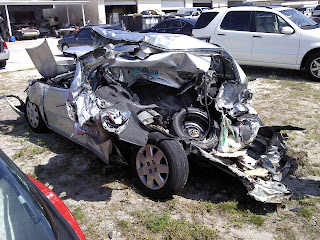
The functionality of my body saved my life and gave me the ability to get through that accident without putting me in a wheel chair for the rest of my life (or worse). Personally I only focus on function and I think form has followed quite well, but it wasn't my size 3 (or whatever) pants that saved me that day. Something to think about.
Live well and the rest will follow,
Cassandra Wyzik
ACSM Certified Personal Trainer
Satellite Beach, Brevard County
www.FitToYouBrevard.com
If you concentrate on getting stronger, faster, more flexible, etc than you are now, you will lose weight, feel wonderful, have fun, and you'll get where you want to be. Constantly focusing on how you're not there yet will lead to you never getting there at all. It's frustrating for me to see how some people literally only care about the aesthetics of their body and not with how functional or healthy it is (or isn't). You can be as skinny and hot as you want, but a heart attack will kill you just the same. You can be as skinny and hot as you want, but when it comes time to move your furniture around and there's no one to help you it will do you absolutely no good. Osteoporosis doesn't care if you're aesthetically pleasing, nor does cancer, diabetes, high blood pressure, the list goes on.
Please think about what being active and eating a healthy diet do for your living longer, living healthier, living happier, being more functional, and warding off diseases instead of what size jeans you think will make you perfect (even if you have to cram into them dammit!). Form will follow function.
Being fit and healthy will do more for you than you ever imagined. Have you ever been in a car accident? Were you hurt? If so, would you give anything to not be hurt? You may know that in March 2011 I was in a very serious car accident. I was stopped in a line of traffic in my Honda Civic and got rear ended at about 40 miles per hour by an International truck into another International truck. Everyone who saw the wreckage assumed I was dead because no one could have survived it. Including the guy at the impound lot when I went to get my stuff out my car the next day. Yes, I walked in there the next day to get my stuff out of my car after that. I was sore for a couple weeks, but I walked away from this:


with whiplash that subsided within a couple weeks and a minor bulging disc in my lumbar. That's it. If you know anything about these kinds of accidents, if you do survive them you generally have major back injuries, shoulder injuries, hand injuries, brain injuries, and who knows what else. I basically walked away unharmed. Why? My doctors and myself credit my muscular strength and flexibility. I saw the truck about to hit me the moment before it happened and covered my head with my arms and tensed my entire body to it's limit (involuntarily, believe me). My muscles were strong enough that they shielded every joint in my body. My flexibility level allowed my muscles, tendons, and ligaments to stretch with the forces of the impact to keep them from tearing. The functionality of my body saved my life and gave me the ability to get through that accident without putting me in a wheel chair for the rest of my life (or worse). Personally I only focus on function and I think form has followed quite well, but it wasn't my size 3 (or whatever) pants that saved me that day. Something to think about.
Live well and the rest will follow,
Cassandra Wyzik
ACSM Certified Personal Trainer
Satellite Beach, Brevard County
www.FitToYouBrevard.com
Sunday, January 22, 2012
More Ovaltine Please!
Ok, so I don't generally endorse supplementation because it's much better to get all your nutrients from whole foods (track your diet with My Fitness Pal and you'll know you're always on target!), but if you have a child like mine who doesn't eat much (and certainly not always the right things) then sometimes you don't have much of an option.
Enter Ovaltine. There's a bunch of vitamins and minerals in it with very few calories and it's CHOCOLATE! I put it in a cup full of whole milk for my son and let him go at it, he loves it. Sometimes I put it in coffee for myself and holy moly is it good.
Check out the nutrient breakdown:

Enter Ovaltine. There's a bunch of vitamins and minerals in it with very few calories and it's CHOCOLATE! I put it in a cup full of whole milk for my son and let him go at it, he loves it. Sometimes I put it in coffee for myself and holy moly is it good.
Check out the nutrient breakdown:
So there's not exactly your whole daily requirement of anything in here, but I think that's also a plus. You don't want to get TOO much of any one thing and this is pretty balanced and again, very few calories. If you have a chocolate monkey on your back, this could be your saving grace!
Enjoy!
Cassandra Wyzik
Insulin
Oy, it's been a minute since I blogged. I'm going to try to make up for lost time today and do a blogging spree! First order of the day is to discuss the roll insulin plays in our body and how it pertains to weight loss and gain.
I really don't think I can sum it up better than this article, so I'm going to copy and paste here:
Insulin and Weight Loss
- The master weight loss hormone is insulin
- Insulin removes sugar from your blood
- Insulin resistance occurs when your cells don't use insulin properly
The master weight loss hormone is insulin. Master insulin control and you will master your weight. Understand how insulin works and you will understand all the keys to weight loss
What Insulin Does
- Lowers blood sugar
- Stores energy in the liver as glycogen
- Moves sugar (glucose) from the blood to the cells
When insulin is not present this acts as a "red light". Sugar does not move from the blood to your cells without a signal from insulin.
The actual work of transporting sugar into the cells is reserved for special proteins in the cell wall called Glut 4 proteins, but without the signal from insulin on specialized receptors, these proteins can't do their work.
The Problem of Insulin Resistance
Too much insulin damages cells
Insulin resistance makes you fat
insulin resistance has a snowball effect on your weight
How insulin Resistance Damages Cells
The problem with insulin resistance is that when cells become resistant to insulin, your body starts to make more and more insulin to solve the problem. This makes the problem of insulin resistance worse. Your body has a special class of proteins, called Heat Shock Proteins. Heat Shock Proteins serve to reduce inflammation brought on by overheating. Insulin resistance disrupts the action of heat shock proteins, which leads to damage to cells. Additionally, too much insulin damages the delicate balance cells require to function. For example, insulin acts as an important signal for calcium and magnesium influx into the cell. This becomes compromised by insulin resistance.
How insulin Resistance Makes You Fat
When your cells become insulin resistant, your body has no choice but to store the sugar in your blood as fat. When you eat foods that quickly raise blood sugar, or require a lot of insulin such as a lot of processed carbohydrates at once (like a glass of orange juice) the excess blood sugar gets stored as fat.
How insulin Resistance Promotes belly fat
The key thing to understand about insulin resistance is that it affects different types of cells differently. What this means is that insulin resistance can often be localized to certain areas and types of cells!
Fat cells in the midsection are often a prime culprit with insulin resistance. These cells become damaged. New research shows these cells suffer from hypoxia (lack of oxygen) resulting from inflammation and restricted blood flow. The fat cells in this region become insulin resistant and tend to store fat more readily. People who struggle with belly fat in reality struggle with damaged fat cells in the stomach region.
END ARTICLE
Right so what this all means, if you were having any trouble, is that when you eat something with lots of sugar in it, it causes a spike in insulin levels in your blood to remove it from your blood stream. When this happens too often or lots more sugar is ingested than can be removed from your blood stream by insulin, you store it as fat, usually belly fat. It can also lead to insulin resistance which, as stated above, has a cascading effect and makes everything worse and worse.
What can we do? Stick to slow digesting carbohydrates, ones that digest more slowly and do not cause such spikes in your insulin levels. Stay away from simple carbs that spike your insulin levels over and over and over again. Here is a list to help you out!
SLOW DIGESTING CARBS
- Oatmeal - I have oatmeal (high fiber) for breakfast every morning. Love it with some fruit in it.
- Steel Cut Oats
- Fruit - All fruits are great but some are better than others for different reasons. Blueberries are at the top of the list for antioxidants and bananas are great for post-workout carbs. The majority of them digest faster than complex carbs so they are best used in the AM or pre and post workout.
- Vegetables - You really can't go wrong when you eat veggies. Veggies are a great source of fiber. Try to have some in every meal.
- Sweet Potatoes/Yams (without gobs of brown sugar on them!)
- Brown Rice
- White Rice - Faster digesting carb, not as good as brown rice.
- Whole Wheat Bread
- Seeds/Nuts (just don't go too crazy with these as they are high in calories, but VERY healthy!)
Until next time!
Cassandra Wyzik
ACSM Certified Personal Trainer
www.FitToYouBrevard.com
Saturday, January 14, 2012
23 1/2 hours
Amazing video! Do yourself a favor and watch it!
He has an amazing point. I know it doesn't usually feel like there is enough time in the day, but that's when we need to step back, plan, prioritize, and consider the message from this comic:

Current research is now suggesting that it isn't only a factor of how many hours per week you're exercising that affects your health, but also the amount of time you spend sitting. So of two people who exercise 5 hours a week, one sits the rest of the time and the other sits only 4 hours a day. We're learning that the person sitting less throughout the day, even though they both exercise the same amount of time, is much healthier. So see how many hours you can not be sitting today (or tomorrow, etc) and try to beat your record!
"Health is the greatest wealth"
Cassandra Wyzik
B.S. - ACSM Certified Personal Trainer
www.FitToYouBrevard.com
He has an amazing point. I know it doesn't usually feel like there is enough time in the day, but that's when we need to step back, plan, prioritize, and consider the message from this comic:

It seems to me like some of the things we do with the 16 or so hours we're awake every day do not serve to improve our lives. Stress, worrying over money, dealing with drama, being stuck in a job you hate, whatever is dragging you down is actively shortening your life and reducing the quality of that life at the same time. It's important to pick battles and decide what is important enough to invest energy in and what is best left alone. As Dr. Evans says, exercise is the most important thing you could add to make a big difference in your life compared to your investment in it. It's like choosing to eat a Larabar over a doughnut. You're trading in something that hurts you for something that helps you. So instead of worrying about 1000 things you can't change, use that time to get some exercise and your stress with be reduced along with all the other benefits exercise gives you!Current research is now suggesting that it isn't only a factor of how many hours per week you're exercising that affects your health, but also the amount of time you spend sitting. So of two people who exercise 5 hours a week, one sits the rest of the time and the other sits only 4 hours a day. We're learning that the person sitting less throughout the day, even though they both exercise the same amount of time, is much healthier. So see how many hours you can not be sitting today (or tomorrow, etc) and try to beat your record!
"Health is the greatest wealth"
Cassandra Wyzik
B.S. - ACSM Certified Personal Trainer
www.FitToYouBrevard.com
Photoshop
I think that so many of our self esteem issues come from the unrealistic image of what we're "supposed" to look like put forth by the media. Most of these women aren't as flawless as they appear and even the ones who are close have trainers, nutritionists, stylists, and all the money they need to buy any product available that will help them look the way they do. And they have nannies and mannies to take care of the kids so they can work out 3 hours a day and spend an hour with their makeup artist in the morning or whatever else they do to look they way they do. I mean, what mortal woman in the working world (god forbid with kids) can compete?
It's really just as bad for men too. The message to them is chiseled abs, perfect amount of facial hair just here and there, no body hair, etc is the male ideal. But the same holds true for the men of Hollywood et all as for the women. They get paid to look the way they do, do you? Do you have a nanny for your kids so you can go workout every day? Do you have housekeepers and a chef so you don't have to worry about lifting a finger? I highly doubt anyone reading this has said yes to any of the above, because IT'S NOT NORMAL! We get bombarded with the images of an elite few all day and are expected to keep up? Well screw that! I happened across this video today that I think is amazing:
I think the most important thing to note is that the women in the fake commercial before Photoshop look pretty normal, despite the nannies and chefs and trainers and whatever products they use to take the years off. So for all my fellow normal people out there, look in the mirror, love what you see, focus on being healthy above all else, be a good person, and the beauty happens all it's own!
There's a difference between being alive and living!
Cassandra Wyzik
B.S. - ACSM Certified Personal Trainer
www.FitToYouBrevard.com
It's really just as bad for men too. The message to them is chiseled abs, perfect amount of facial hair just here and there, no body hair, etc is the male ideal. But the same holds true for the men of Hollywood et all as for the women. They get paid to look the way they do, do you? Do you have a nanny for your kids so you can go workout every day? Do you have housekeepers and a chef so you don't have to worry about lifting a finger? I highly doubt anyone reading this has said yes to any of the above, because IT'S NOT NORMAL! We get bombarded with the images of an elite few all day and are expected to keep up? Well screw that! I happened across this video today that I think is amazing:
I think the most important thing to note is that the women in the fake commercial before Photoshop look pretty normal, despite the nannies and chefs and trainers and whatever products they use to take the years off. So for all my fellow normal people out there, look in the mirror, love what you see, focus on being healthy above all else, be a good person, and the beauty happens all it's own!
There's a difference between being alive and living!
Cassandra Wyzik
B.S. - ACSM Certified Personal Trainer
www.FitToYouBrevard.com
Subscribe to:
Posts (Atom)